
Back to Blogs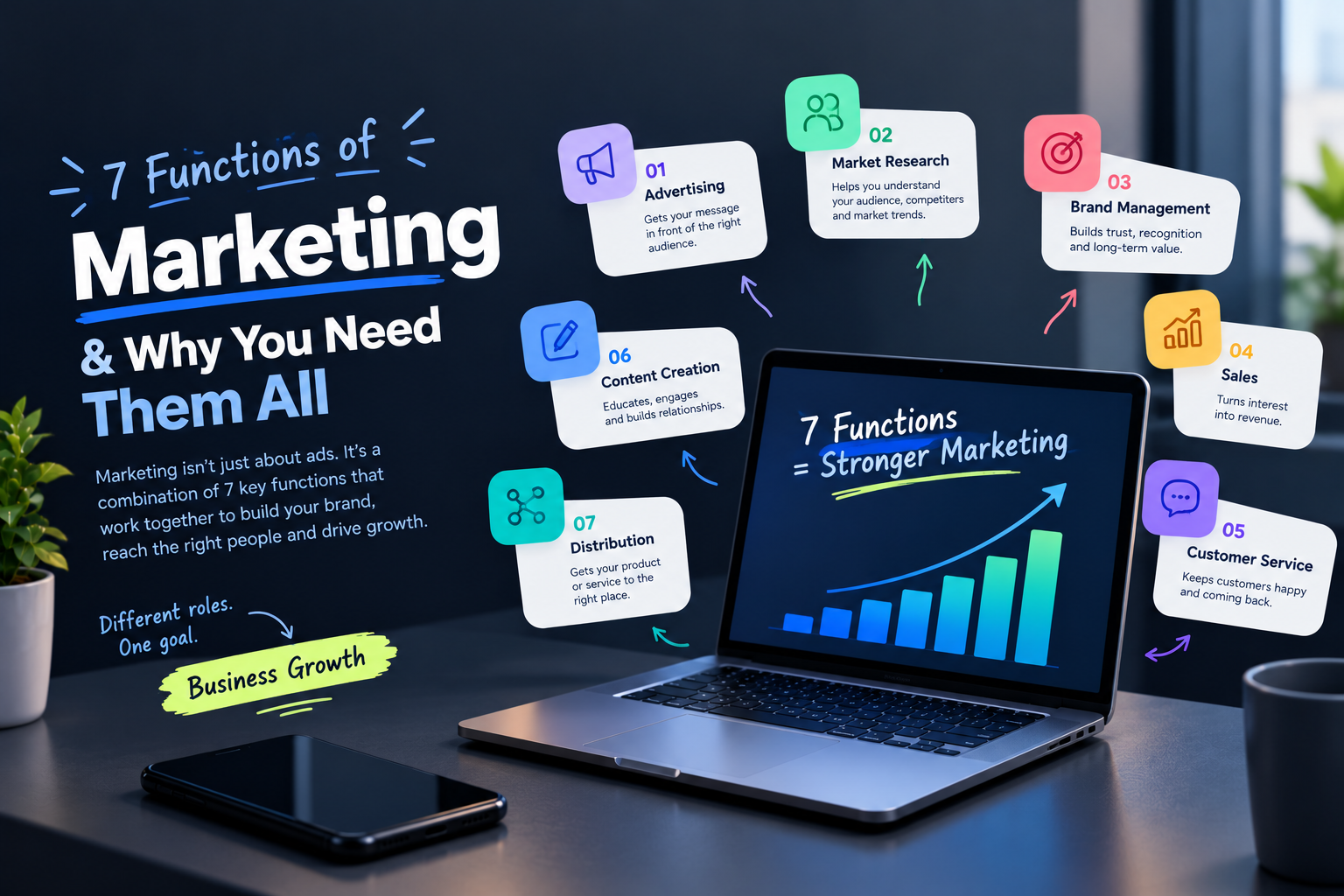
7 Functions of Marketing & Why You Need Them All
7 Functions of Marketing & Why You Need Them All
The 7 core functions of marketing are promotion, pricing, selling, product management, marketing management, financing, and distribution.
The intention behind marketing your product is mainly to increase sales.
Marketing your product the right way is crucial to sales and requires a careful and strategic approach. If done incorrectly, it not only wastes the effort put into the product but also causes a significant setback for the company.
Each function answers a different business question.
What should you sell?
What should it cost?
How will people find it?
How will you measure whether your efforts are working?
What Are The Functions Of Marketing?
The functions of marketing are the core activities that help businesses understand markets, create suitable offerings, communicate value, complete sales, and make products available.
7 Marketing Functions Everyone Should Know
1. Product Management
Product management starts with understanding what customers actually need. It is not only about creating something new.
It also involves improving an existing product as customer expectations change. Consider it as a roadmap paving your way.
Key areas include:
Understanding customer needs before developing or changing an offer
Product development based on market demand and customer feedback
Product positioning that gives customers a clear reason to choose it
Product improvements based on reviews, trends, and competitor analysis
Managing product life cycles from launch through maturity and decline
Matching products with market demand instead of relying on assumptions
Here are two ways to manage your product:
Answer The “Whys”
Businesses should also understand the “whys” of their product.
Why does the product or service exist?
Why does someone need it?
Why would they choose it over a competitor?
Why should they buy it now?
Evolve With The Market
Apple provides a useful example. The iPhone has evolved through changes in cameras, processors, displays, software, and other features as consumer expectations have changed.
Product management therefore involves continually evolving the product rather than treating the original version as finished.
2. Pricing
Pricing affects demand, positioning, revenue, and profit. A price should reflect both business costs and the value customers believe they are receiving.
Important pricing factors include:
Cost considerations
Customer willingness to pay
Competitor pricing
Perceived value
Discounts and promotions
Profit margins
Psychological pricing
The Hermès Birkin is a useful example of how pricing can work alongside scarcity and perceived value.
Limited supply and strong demand influence the market value of sought-after Birkin bags, while craftsmanship, materials, rarity, and provenance also affect prices.
This shows why pricing is not simply a calculation based on production cost. Customers also respond to:
Brand positioning
Availability
Brand perception
Value attributed
Professional digital marketing services can help businesses develop a good brand value in front of customers.
3. Promotion
Promotion makes customers aware of an offer and gives them information that can influence their decision.
Here’s how you promote your product or service in the market:
Create awareness
Before marketing your product/service, educate your audience on:
What the product/service is?
What it does?
How it helps people?
Position your brand as something that is needed but unknown in your audience’s persona.
Introduce to potential customers.
Research what category of people is willing to buy your offer. Research about:
Gender
Age
Race
Socioeconomic class
Location
Your brand’s GMB SEO can help you reach your target audience.
Informal endorsement
Take advantage of existing customers, who can play a crucial role in informally endorsing a product.
This can be done by sending them a message or an email.
Promotional prices
Entice your customers to try your product/service at a promotional price rather than paying its full price.
This psychologically tricks them into buying your product/service.
Using the uniqueness of the product
Figure out what one thing makes your product or service different than others and promote your product/service through:
Advertising
Content marketing
Social media marketing
Search engine optimization
Email marketing
Public relations
Influencer marketing
Sales promotions
A business can also explain a product's unique feature through educational content.
4. Selling
Promotion creates interest, but selling helps turn that interest into a transaction.
The selling process can include:
Lead generation
Prospect qualification
Sales conversations
Product demonstrations
Objection handling
Negotiation
Closing
Customer relationship management
A simple example is KFC’s student-focused promotions. A student may first discover an offer through advertising, but the actual purchase still depends on the offer being clear, accessible, and suitable for that customer's budget.
Selling therefore connects marketing attention with revenue. It also provides useful feedback about what customers ask, reject, or value.
5. Distribution
Distribution determines how customers get the product or service.
It can involve:
Distribution channels
Retail
E-commerce
Wholesalers
Direct-to-consumer models
Logistics
Delivery
Online distribution for digital products
A product can have strong demand and still lose sales if customers cannot easily access it.
For digital businesses, websites, online marketplaces, apps, and e-commerce stores can serve as important distribution channels.
6. Marketing Information Management
Marketing decisions should be based on information rather than guesswork.
This function can include:
Customer research
Competitor research
Market trends
Website analytics
Search data
Customer feedback
Campaign performance
Conversion data
A business may use click-through rate data to understand how people respond to an advertisement or search result.
Search behaviour can also reveal what customers want before they make a purchase. This information can guide products, campaigns, content, pricing, and sales decisions.
7. Financing
Marketing requires resources. Financing determines how those resources are planned and allocated.
Businesses may need budgets for:
Marketing budgets
Advertising investment
Product development costs
Distribution costs
Sales costs
Customer acquisition costs
Return on marketing investment
Sackcloth & Ashes provides an interesting example of values supporting marketing activity.
The brand promotes blankets made with eco-conscious materials and has a giving model in which a blanket is donated to a homeless shelter for each blanket gifted.
That connection between product, purpose, promotion, and customer values can make the brand's message more meaningful to its target audience.
Why You Need All 7 Functions of Marketing
The 7 functions of marketing work as a connected system. Weakness in one area can affect the others.
1. Mutual Support
A product needs the right price and promotion. Promotion needs a product that delivers on its claims. Sales need qualified leads, while distribution needs enough demand to justify its costs.
2. Preventing Failures
Here is a look at how all functions collectively reduce these failures:
| Errors | Likely Problem |
|---|---|
| Great product + poor promotion | Low awareness |
| Strong promotion + poor product | Dissatisfied customers |
| Good product + wrong pricing | Weak conversions |
| High demand + poor distribution | Missed sales |
| Large marketing budget + poor data | Inefficient spending |
3. Customer Satisfaction
Customer satisfaction depends on more than product quality.
It depends on:
Product quality
Fair pricing
Clear communication
Convenient purchasing
Availability
Post-purchase feedback
4. Complete Strategy
Using all seven areas gives marketers a broader view of the customer journey. It prevents teams from treating advertising as the entire marketing process.
A Digital Marketing Agency may support several of these areas at the same time, particularly promotion, selling, information management, and customer acquisition.
5. Data-Driven Decisions
Data can improve:
Pricing
Products
Campaigns
Distribution
Sales processes
Marketing budgets
How The Marketing Functions Can Scale Up Your Business
1. Understand Your Market
Use market and customer information to identify opportunities.
2. Build the Right Offering
Use customer insights to improve the product or service.
3. Establish the Right Price
Balance:
Customer value
Market conditions
Costs
Business objectives
Customer budget
4. Promote to the Right Audience
Use SEO, content, paid advertising, social media, email, and other suitable channels.
Learning how to schedule social media posts can also help teams maintain a consistent publishing process.
5. Convert Interest Into Sales
Use clear offers, strong landing pages, sales conversations, and follow-up systems.
6. Make the Offering Accessible
Remove barriers that make purchasing difficult, whether they involve delivery, payment, availability, or website usability.
7. Measure and Reinvest
Review performance data and put more resources into activities that support business goals.
How Digital Marketing Supports the 7 Functions of Marketing
Digital channels now support nearly every marketing function.
| Function | Digital Marketing Support |
|---|---|
| Product Management | Customer research, reviews, search trends |
| Pricing | Competitor research and demand insights |
| Promotion | SEO, PPC, social media, content marketing |
| Selling | Landing pages, CRO, lead generation |
| Distribution | E-commerce, websites, online marketplaces |
| Information Management | Analytics, Search Console, CRM data |
| Financing | Budget allocation and campaign ROI tracking |
Businesses can also use tools such as “My Google Activity” to understand personal Google account activity, while business analytics platforms provide more appropriate data for measuring marketing performance.
Common Mistakes Businesses Make With Marketing Functions
Many businesses focus heavily on promotion while neglecting the other areas.
1. Focusing Only on Promotion
2. Ignoring Customer and Market Data
3. Treating Marketing and Sales as Completely Separate
4. Setting Prices Without Understanding Perceived Value
5. Neglecting Distribution and Customer Convenience
6. Spending Without Measuring Results
Conclusion
The seven core functions provide a practical way to understand how marketing supports business growth.
Product management shapes the offer
Pricing sets its commercial position
Promotion creates awareness
Selling converts interest.
Distribution makes the offer accessible
Information management supports better decisions
Financing gives the strategy the resources it needs.
For students and marketers, learning these functions creates a stronger foundation for understanding digital marketing.
For businesses, it provides a simple framework for finding gaps in their current strategy.
For more information, contact us and explore how Werx Vision can help marketers expand their careers and businesses spike their growth.
FAQs
Common Questions
The seven functions are product management, pricing, promotion, selling, distribution, marketing information management, and financing.
They help businesses create the right offer, reach customers, generate sales, manage resources, and make informed marketing decisions.
Digital marketing supports research, promotion, selling, distribution, analytics, pricing insights, and ROI tracking across the customer journey.
Focusing only on promotion can lead to poor pricing, weak products, inefficient spending, limited distribution, and missed customer needs.
Businesses can use the seven functions to understand customers, improve offerings, set prices, promote effectively, increase sales, and measure results.